
These past two days I have started with a project that I had saved for a long time, which is none other than making a cooling chimney for a nuclear power plant for the Páramo. The first thing was to find a pot with the appropriate curved shape and an acceptable size: I liked the one I chose because of its shape and the stripes it has, which imitate the marks of the formwork on the concrete, but I admit that it is a little small. In any case, if such a fireplace were made to scale it would take up almost the entire game table (I estimate that it would need at least 80 cm in diameter, the one I bought is 25 cm) and at this size it is easier to transport without a doubt.

First step: buy the pot in the Chinese store (3.50 euros)
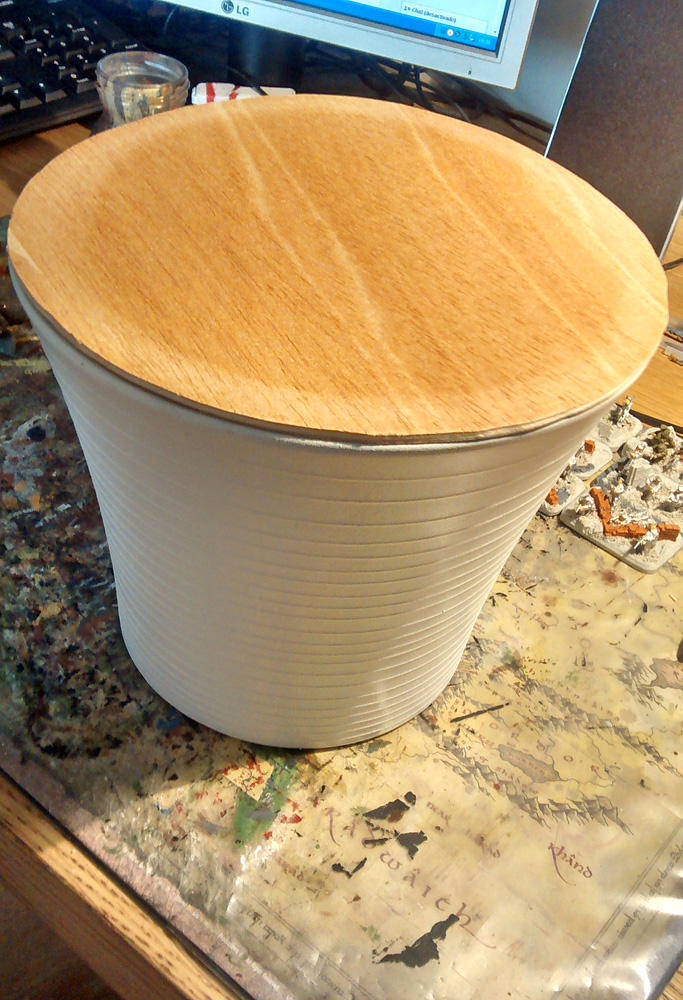
Then a cover is cut for the bottom part, which will be where the legs rest.

Next, the legs themselves are cut from a 0.5 cm diameter wooden strip (I bought two, at 0.75 cents per strip). The length? Well, so that a miniature can be accommodated underneath, since in theory the passage is open, I decided to make them 5 cm. long.

Once they are all cut, some spokes are drawn on the lid to know where they are placed.

Some nails are inserted into the ends of each “spoke”, for naval modeling…

And the lid is turned over, so that each leg can be nailed into place with a drop of white glue to strengthen the union as much as possible.

The lid with the eight legs and the pot on top. Here I have to say that I gave it few legs, since it should have more and more together (probably, as many others interspersed in the eight that it has), but we are not going to present the model to an architectural competition, so… It holds the weight, which is the important thing.

Even so, the diagonal crossbars are missing, which will give even more strength to the structure (and which are the ones actually carried by the chimney). These are a little longer, they came out to me about 8 or 9 cm. each.

The lower structure, finished.

At the top I made a section of collapsed wall with Das Pronto, above the bottom of the pot, so that it gained height and could hide the bottom of the pot a little.

With a hammer, a cutter and great care, we proceed to cause damage to the surface of the chimney, such as a gap, scratches, cracks and other structural damage.

And first coat of paint, in Vallejo Basalt Gray. Remember to also paint the bottom of the pot with Matte Black.

Vallejo Medium Gray dry brush and first stains with inks.

The painting is now finished, with another dry brush in Medium Gray and all the given inks (Asurmen Blue, Athonian Camoshade, Reikland Fleshshade and Devlan Mud from Games Workshop). The inks are as cool as they come, imitating moss, general dirt, rips from bad products or whatever.

A touch of detail: the irons of the armor sticking out into the air, twisted. With a few simple 1mm diameter clips, cut and twisted in any way, it is done perfectly. The Das Pronto is soft enough, even after drying, to allow us to stick them wherever we want.


Other details: a couple of signs to put on the legs of the fireplace:

And the invention already finished, placed with the other scenery. It is, as I have already said, a little small for a nuclear one, but it could be a chimney from any other factory, such as a thermal one.
To give it greater support and an extra touch of realism, a container of CDs (in this case, 25 discs) can be added as part of the interior structure under the fireplace, where all types of ducts, control and access rooms are located. You simply have to paint it in the same colors as the rest of the fireplace and add graffiti to suit the consumer. It also gets dirty with brown, green inks and all kinds of moss we want.

Once placed under the fireplace, between the support posts, the effect is much better and more realistic.